
Typing Quiz
How fast do you really type — and how accurately? Start typing the passage below and the timer starts with your first keystroke. When time is up you get your words per minute, accuracy and the keys you missed most. Then test your touch-typing knowledge with a short quiz.
- Free to use
- No sign-up
- Runs in your browser
Typing test and quiz
Touch-typing quiz
Typing Practice Pack
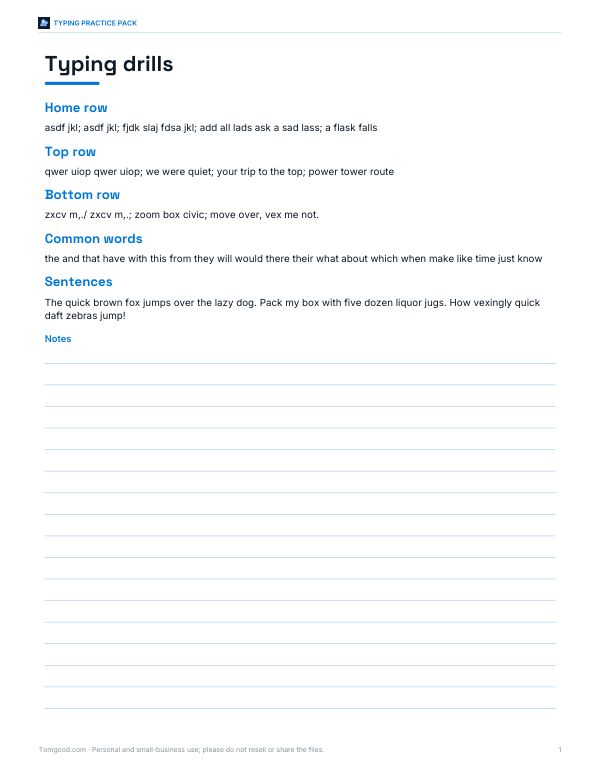
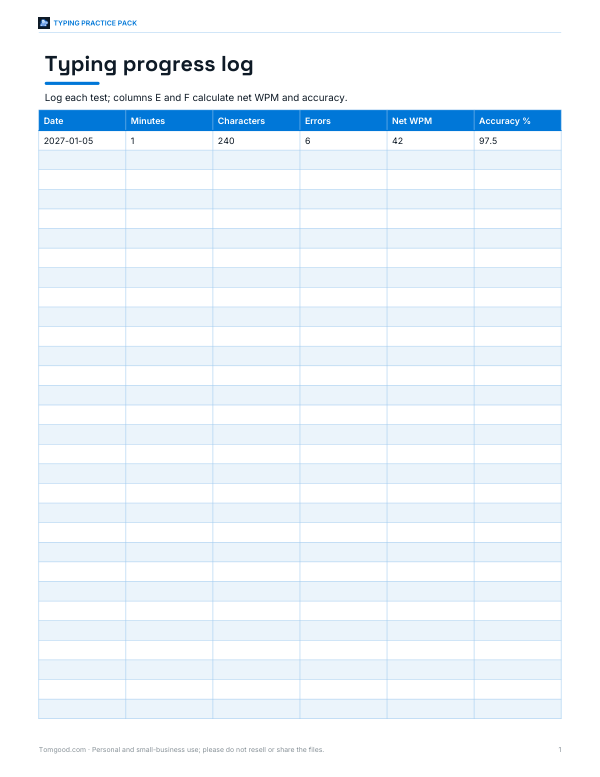
Printable touch-typing finger chart, home-row and top-row drill sheets, a progress log spreadsheet that tracks WPM and accuracy, and a printable typing certificate.
- Finger chart (PDF)
- Drill sheets (PDF/DOCX)
- Progress log (XLSX)
- Certificate (PDF)
Formats: PDF, DOCX, XLSX. Instant download after payment (link valid 72 hours, up to 5 downloads). AI-assisted: the templates were drafted with AI help and reviewed and laid out before publishing.
$5.00 USD, one-time 4 files · about $1.25 each
- Instant download
- 7-day refund
- Secure checkout by Stripe
7-day money-back guarantee. Full refund within 7 days of purchase, even after you download.
Free sample: Finger Chart (PDF, 50 KB)
Full refund within 7 days — see the refund policy and license.
Free printables
Single sheets you can print right now, no sign-up. The full pack adds every sheet in one download plus the editable files.
 Printable Typing Certificate PDF
How the typing test is scored
| Measure | How it is calculated |
|---|---|
| Gross WPM | All characters typed ÷ 5, divided by minutes |
| Net WPM | Gross WPM minus uncorrected errors per minute |
| Accuracy | Correct characters ÷ characters typed × 100 |
| Most-missed keys | The expected characters you typed wrongly most often |
A “word” is standardised as five characters including spaces, so results are comparable whatever the passage. The timer starts on your first keystroke and pasting is disabled.
What is a good typing speed?
| Speed (net WPM) | Typical description |
|---|---|
| Under 25 | Beginner or hunt-and-peck |
| 25–40 | Average for casual typists |
| 40–60 | Good; comfortable for most office work |
| 60–80 | Fast; common among frequent typists |
| Over 80 | Very fast |
These bands are rough guides rather than official standards. Some jobs, such as transcription or data entry, may ask for a tested speed, often together with a minimum accuracy.
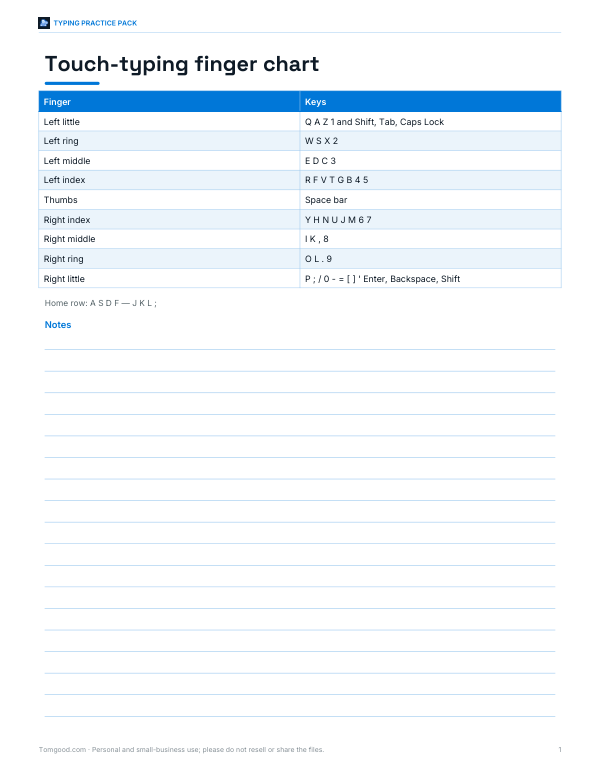
Touch-typing finger chart
| Finger | Keys |
|---|---|
| Left little | Q A Z 1 and Shift, Tab, Caps Lock |
| Left ring | W S X 2 |
| Left middle | E D C 3 |
| Left index | R F V T G B 4 5 |
| Thumbs | Space bar |
| Right index | Y H N U J M 6 7 |
| Right middle | I K , 8 |
| Right ring | O L . 9 |
| Right little | P ; / 0 - = [ ] ' Enter, Backspace, Shift |
Rest your fingers on the home row — A S D F for the left hand and J K L ; for the right — using the small bumps on F and J to find it without looking. Each finger reaches up and down from its home key and returns there.
Worked example
A student takes the 1-minute test and types 240 characters with 6 mistakes left uncorrected. Gross speed is 240 ÷ 5 = 48 WPM; net speed is 48 − 6 = 42 WPM; accuracy is 234 ÷ 240 = 97.5%. The most-missed keys are “e” and the space bar, so they practise drills focused on the left middle finger and on keeping a steady rhythm between words.
How to improve
- Practise little and often: 10–15 minutes a day beats an hour once a week.
- Keep your eyes on the screen, not the keyboard.
- Aim for accuracy of 95% or better before pushing speed.
- Drill your most-missed keys in short words and pairs.
- Use all ten fingers — it feels slower at first but pays off quickly.
- Sit with feet flat, wrists level and the screen at eye level.
The practice passages
| # | Passage |
|---|---|
| 1 | The small bakery on the corner opens before sunrise. By six o’clock the windows are fogged with steam, and a line of sleepy commuters waits for warm rolls, strong coffee and a friendly word from the baker, who has learned most of their names over the years. |
| 2 | Good maps do more than show roads. They help us understand the shape of a place: where rivers bend, where hills rise and where towns grew up beside bridges and crossroads. Learning to read one well is a skill that lasts a lifetime. |
| 3 | When you practise typing, accuracy comes first. Keep your fingers resting on the home row, look at the screen instead of the keys, and let speed build slowly. A steady rhythm will carry you further than bursts of fast, careless keystrokes. |
| 4 | Every autumn the geese fly south in long, uneven lines. Farmers look up from their fields, children point from school yards, and for a moment the whole valley seems to pause and listen to the distant, restless calling overhead. |
| 5 | A good recipe is really a set of clear instructions. It lists the ingredients in order, gives exact quantities, explains each step in plain words and tells you what the dish should look like when it is ready to serve. |
| 6 | The library was quiet except for the soft turning of pages and the occasional squeak of a trolley wheel. In the corner, a boy read about volcanoes, a woman studied for an exam, and an old man carefully solved the daily crossword puzzle. |
All six passages are original and use ordinary vocabulary with a mix of punctuation, so scores reflect everyday typing rather than memorised word lists. For longer tests, the next passage is added automatically so you never run out of text.
Typing tests for job applications
Some employers ask for a typing test, especially for administrative, data-entry, customer-service and transcription roles. They usually report net WPM and accuracy, and many set a minimum accuracy as well as a speed. Practise with the same duration the employer uses, keep your eyes on the text, and correct errors only if the test counts corrected characters — some tests penalise backspacing time, others penalise uncorrected errors. Ask the employer which rules apply if the instructions are unclear.
Healthy typing habits
- Keep wrists straight and floating, not resting on a sharp desk edge.
- Type with a light touch — keys only need to reach the bottom.
- Take a short break every 30–60 minutes to stretch hands and shoulders.
- Adjust chair height so elbows are at about 90 degrees.
- If you feel pain, numbness or tingling, stop and seek medical advice.
About the quiz
The ten quiz questions cover the home row, which finger presses common keys, how WPM is measured and healthy posture. Each answer highlights the correct option so you learn as you go.
Privacy
Your typing is analysed in your browser and never uploaded.
Frequently asked questions
What is the average typing speed?
Many casual typists fall around 35–45 WPM; frequent typists are often faster.
What is the difference between gross and net WPM?
Net WPM subtracts uncorrected errors; gross WPM does not.
Does a word mean an actual word?
No — a standard word is five characters including spaces.
Why can’t I paste text?
Pasting is disabled so the test measures your typing.
How long should a typing test be?
One minute is common; longer tests give steadier results.
Is my typing uploaded?
No. Everything stays in your browser.
Should I use backspace during the test?
Yes — corrected mistakes don’t count against net WPM, though correcting takes time.
How long does it take to learn touch typing?
Many learners reach their old speed within a few weeks of daily practice, then keep improving.